Specialty Baristas
Define the actual specialty baristas duties, level, tools or systems, reporting line, location and pass evidence before profiles are requested.
 AL AHAD GROUP
Employer guide to filipino baristas in saudi arabia: roles, evidence, shifts, welfare, official Philippines requirements and documented next steps.
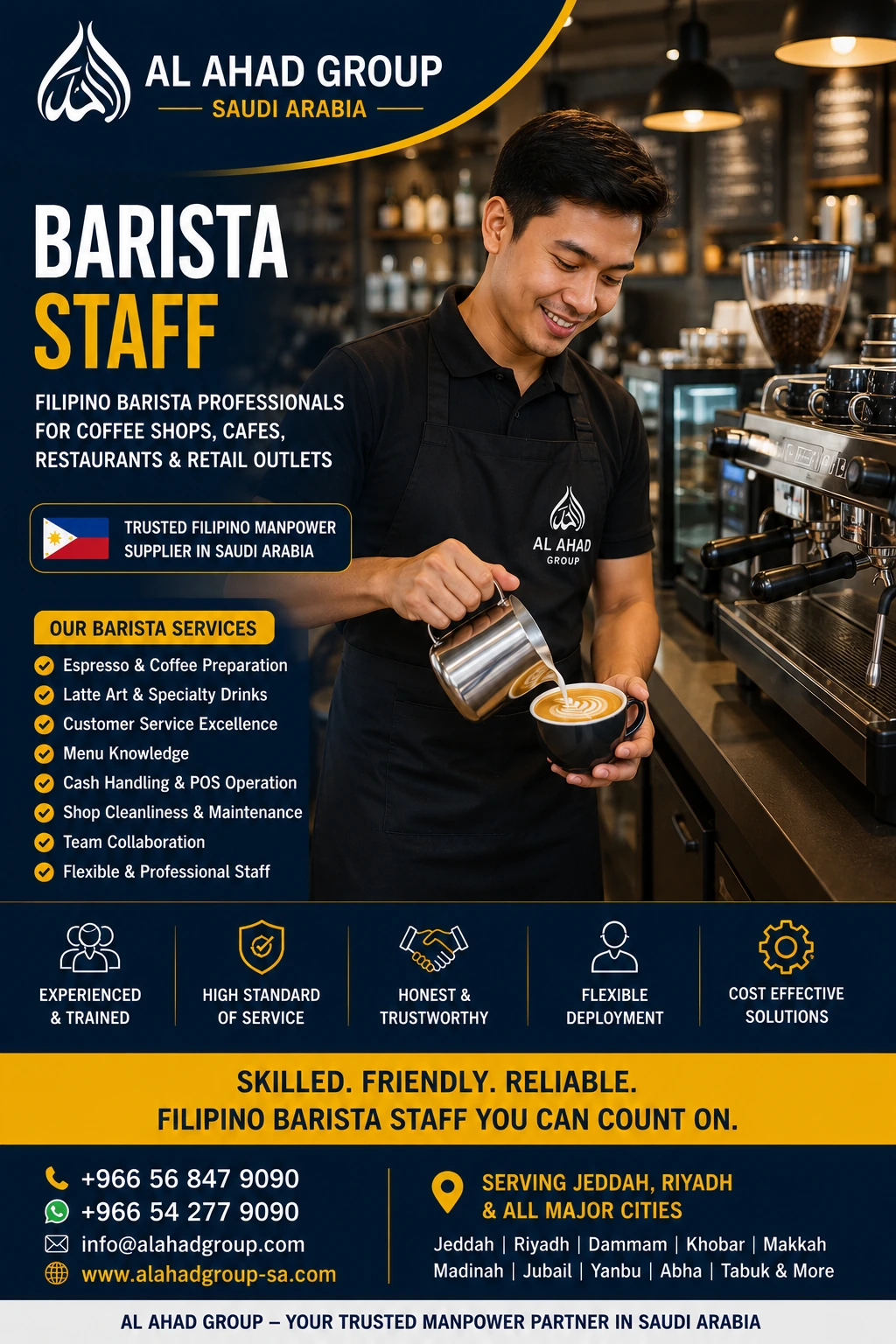
Use Filipino Baristas in Saudi Arabia as a planning label, then replace it with six actual job briefs: specialty baristas, coffee-shop crew, cashier-baristas, shift leads, brew trainers, opening-team members. Each brief needs its own evidence, terms, supervisor and Saudi Arabia worksite. AL AHAD GROUP can review that scope, but selection, eligibility and government processing remain separate decisions.
Define the actual specialty baristas duties, level, tools or systems, reporting line, location and pass evidence before profiles are requested.
Define the actual coffee-shop crew duties, level, tools or systems, reporting line, location and pass evidence before profiles are requested.
Define the actual cashier-baristas duties, level, tools or systems, reporting line, location and pass evidence before profiles are requested.
Define the actual shift leads duties, level, tools or systems, reporting line, location and pass evidence before profiles are requested.
Define the actual brew trainers duties, level, tools or systems, reporting line, location and pass evidence before profiles are requested.
Define the actual opening-team members duties, level, tools or systems, reporting line, location and pass evidence before profiles are requested.
Turn the search phrase into a controlled hiring pack: role schedule, job descriptions, visa occupations, quantities, assessment matrix, decision authority, salary and allowance table, roster, accommodation, transport, insurance and mobilisation tracker. A latte-art photograph is not a complete assessment. Test calibration, recipe consistency, hygiene, throughput, guest interaction and cash or stock responsibilities under realistic conditions. Do not release advertising until those records agree.
Translate this evidence into a pass criterion that can be applied consistently to every shortlisted person.
Verify recency, relevance and authenticity; a document title alone should not decide selection.
Connect this checkpoint with the real equipment, service level, volume or customer situation at the worksite.
Record exceptions and training needs separately so a partial match is not presented as full readiness.
Let an accountable subject-matter assessor review the result before employer approval is logged.
Ask what record, demonstration or reference will prove this item and preserve the assessor's conclusion.
For specialty baristas, connect dial-in demonstration with the operating conditions in specialty cafés. The employer should state how opening calibration affects the position. Ask for a recent work example, then test the system, tool or service decision the worker would face on the stated site.
For coffee-shop crew, connect milk-texture assessment with the operating conditions in hotel lounges. The employer should state how rush-hour station plan affects the position. Compare evidence with the approved duties and reject a profile when the title is similar but the actual exposure is different.
For cashier-baristas, connect workflow speed with the operating conditions in corporate cafés. The employer should state how waste control affects the position. Run a structured scenario, note the candidate's sequence and safety checks, and preserve the reason for the final decision.
For shift leads, connect customer scenario with the operating conditions in airport outlets. The employer should state how clean-down affects the position. Confirm the volume, pace, customer contact and shift conditions behind the experience claim rather than accepting a job title alone.
For brew trainers, connect cash-control awareness with the operating conditions in restaurant groups. The employer should state how stock handover affects the position. Require the supervisor to define first-week competency sign-off so recruitment evidence connects with the real operating handover.
For opening-team members, connect hygiene practice with the operating conditions in event concessions. The employer should state how opening calibration affects the position. Use a witnessed practical task and record the assessor, pass standard and any limits before the candidate reaches an employer interview.
Map the worksite before the worker. At airport outlets, the practical need is shift leads, the proof is customer scenario and the operating dependency is clean-down. At specialty cafés, the equivalent row changes to specialty baristas, dial-in demonstration and opening calibration. The event concessions row covers opening-team members with hygiene practice and opening calibration; hotel lounges instead covers coffee-shop crew with milk-texture assessment and rush-hour station plan. Add restaurant groups for brew trainers and corporate cafés for cashier-baristas. Their gates are cash-control awareness and workflow speed, supported by stock handover and waste control. This role-level matrix gives candidates, assessors, procurement and site operations one auditable definition of the requirement.
Potential operating environments include specialty cafés, hotel lounges, corporate cafés, airport outlets, restaurant groups, and event concessions. These are planning examples, not claims of an exclusive relationship with any named employer or project. Each environment changes the role: a worker in specialty cafés may face different shift, safety, guest, hygiene, system or access controls from the same job title in event concessions. A useful employer brief therefore describes the real site, department, equipment, customer contact, physical conditions and supervisor structure rather than copying a title from another contract.
Model the normal week and the peak case; record the cost and relief implication separately.
Define who approves this control, where evidence is stored and what happens when the target is missed.
Connect this operating decision with the role brief, worker induction and supervisor handover.
Test the assumption with the site team and remove it from the proposal if the employer will not provide it.
Add a dated readiness checkpoint so sourcing does not conceal an unresolved operational dependency.
MWO Riyadh currently describes company job-order verification for companies hiring new low-, semi- and highly skilled Filipino workers. Its skilled and semi-skilled requirements include a detailed demand letter or job order, visa information, a special power of attorney issued to a licensed Philippine recruitment agency, a recruitment agreement, a bilingual master employment contract, company records and worksite information. Requirements can change and a specific occupation may have additional controls. Employers must recheck the live DMW and MWO instructions and should not treat this page as legal advice, a job order, a visa approval or a deployment guarantee.
The Migrant Workers Office says company job-order verification applies to companies hiring new low-, semi- and highly skilled Filipino workers.
The current list includes an employer request, detailed demand letter or job order, visa information, a special power of attorney to a licensed Philippine recruitment agency, recruitment agreement, bilingual master contract, company records and worksite information.
Employers and workers should use the current DMW and MWO instructions for the applicable recruitment channel and should recheck requirements before acting.
Ask each provider to separate sourcing, recruitment, manpower-supply, documentation coordination, travel, accommodation, transport, supervision, payroll, PPE, tools, replacement and managed-service responsibilities. Confirm the legal entity and current authority relevant to the proposed model. Do not accept ‘best’, ‘number one’, ‘fast deployment’ or guaranteed-visa wording as evidence. A transparent proposal shows assumptions, exclusions, dependencies, validity, service levels and how candidate withdrawal, employer changes, delays or unsuccessful assessments are handled.
Send the role, quantity, Saudi Arabia worksite, duties, approved occupation, salary components, roster, start target and assessment method. AL AHAD GROUP can review scope and next steps; it does not guarantee availability, approval or joining.
This page covers planning for specialty baristas, coffee-shop crew, cashier-baristas, shift leads, brew trainers, and opening-team members. A candidate pool can be discussed only after the actual duties and current eligibility are confirmed.
No. Government approvals, current source-country procedures, employer eligibility and candidate readiness sit outside a recruitment marketing claim. The responsible authorities make their own decisions.
Use the same documented role criteria, task evidence, interview questions and employment terms for every candidate. Nationality should not be presented as proof of skill, conduct, language or retention.
There is no honest universal timeline. It depends on the approved role and visa, employer and agency documents, job-order verification, candidate sourcing, interviews, medical or professional requirements, government processing, travel and changes made during the campaign.
Share the role schedule, headcount, Saudi Arabia worksite, roster, employment terms, evidence and target date for a scope review. No candidate selection, job, visa or government approval is promised.