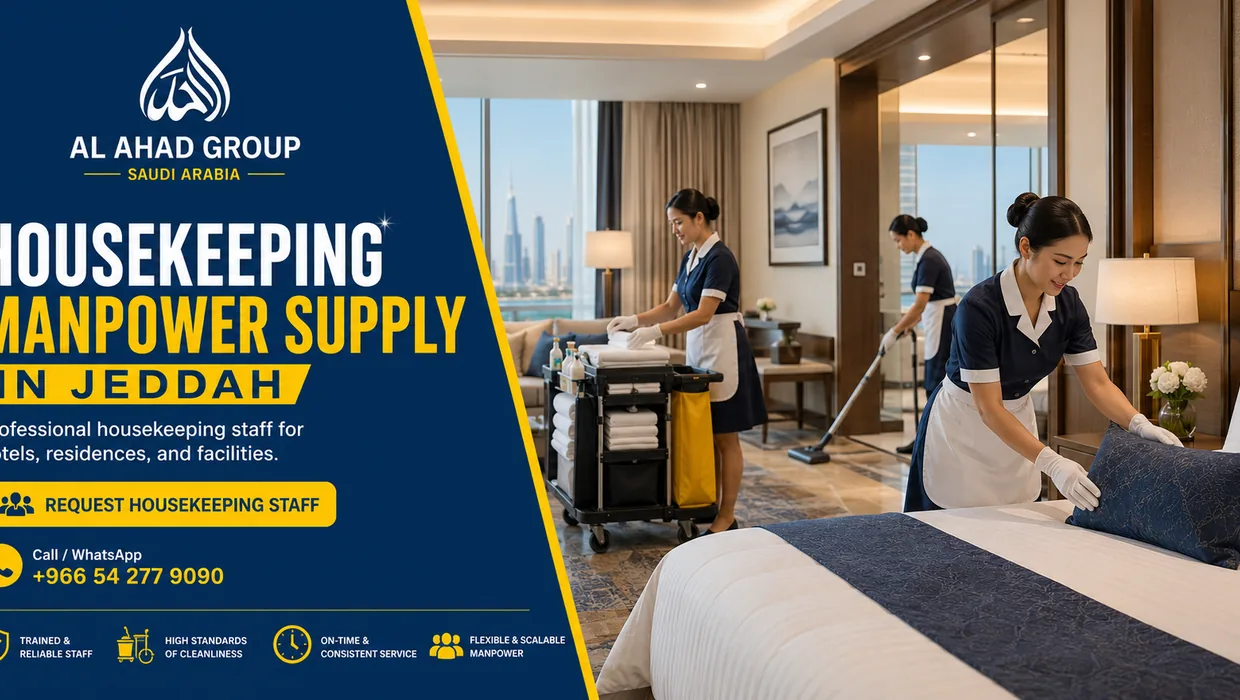
Guest-operation fit
Hotels usually compare room attendants, public-area cleaners, linen support, floor supervisors and backup cover before they choose outsourced housekeeping support.
 AL AHAD GROUP
Outsourced Housekeeping Staff for Hotels helps Saudi employers define worker categories, headcount, work location, shifts, site conditions and the required start date before supply or recruitment is confirmed. Share the approved scope with AL AHAD GROUP so the team can review the practical next step, availability and quotation requirements.
Hotels usually compare room attendants, public-area cleaners, linen support, floor supervisors and backup cover before they choose outsourced housekeeping support.
Peak occupancy periods, checkout windows, shift timing, service standards and replacement speed all affect outsourcing confidence.
Hospitality employers usually trust occupancy and continuity language because it matches how hotel support is evaluated before award.
Outsourced Housekeeping Staff for Hotels should start with the operating context, not a generic support line. Employers usually need the property type, service standards, shift timing, worker categories, supervisor coverage and replacement support clarified before they compare options.
This page now leads with that hospitality requirement so hotels, serviced apartments, restaurants and guest-facing sites can move into quotation with clearer manpower scope.
A sold-out weekend does not leave room for staffing mistakes. If rooms are not turned on time, guest complaints rise, front desk pressure builds, and revenue takes a hit. That is why many operators now rely on outsourced housekeeping staff for hotels to keep room inventory moving, maintain service standards, and avoid the delays that come with constant hiring.
For hotel owners, general managers, and operations teams, housekeeping is not a back-office function. It is directly tied to occupancy, guest ratings, labor cost control, and daily operational stability. When one part of the team is short, the effect shows up everywhere. The real question is not whether housekeeping matters. The question is how to keep it fully supported without carrying unnecessary hiring burden.
Hotels deal with variable demand. One week may be steady, while the next brings group bookings, events, holiday traffic, or last-minute occupancy spikes. Building a full in-house team large enough to cover every peak period can be expensive. Running too lean creates another problem - rooms sit dirty, supervisors stretch too far, and guest readiness falls behind.
This is where outsourced housekeeping staff for hotels becomes a practical business solution. It gives operators access to labor when they need it, without forcing internal teams to spend time on continuous recruitment, onboarding, visa processing, payroll administration, and replacement hiring.
The value is straightforward. Hotels get faster staffing support, more flexible workforce planning, and less disruption when attrition or absenteeism affects operations. Instead of reacting late, management can plan labor around occupancy, turnaround times, and service targets.
For many properties, outsourcing also improves focus. Hotel leadership can spend more time on guest experience, revenue, and property performance instead of chasing attendance issues and urgent manpower gaps.
Housekeeping shortages do not stay contained inside one department. They quickly affect the rest of the property. Front desk teams deal with delayed check-ins. Supervisors rush inspections. Maintenance may face complaints that should have been caught during room preparation. Even food and beverage service can feel the impact if public areas are not cleaned on schedule.
The pressure is usually strongest in a few areas. Room attendants are the obvious need, but linen handling, public area cleaning, floor support, and housekeeping coordination can also become weak points. In larger properties, the challenge is less about one vacancy and more about consistent workforce coverage across shifts, weekends, and high-demand periods.
Hotels in busy markets especially understand this pattern. Demand can change quickly, and labor planning has to respond just as fast. A manpower partner that understands operational urgency is often more useful than a long internal hiring cycle.
Not every staffing arrangement works the same way. Some hotels need full departmental support. Others only need reinforcement during peak periods, pre-opening phases, staff leave coverage, or after sudden turnover. The right approach depends on room count, brand standards, average occupancy, and internal management capacity.
A serious manpower supplier should offer more than headcount. Hotels need workers who can fit into live operations, follow cleaning procedures, support productivity goals, and report reliably. Speed matters, but so does consistency.
When evaluating outsourced housekeeping staff for hotels, decision-makers usually look at a few practical factors. Can the supplier provide job-ready personnel quickly? Can they scale up when occupancy rises? Can they replace absent or underperforming workers without long delays? Can they support labor compliance and reduce the administration sitting on the hotel team?
These are commercial questions, not theoretical ones. If the answer is no, the supplier creates more work than they solve.
Some operators hesitate because they assume outsourcing always costs more. In practice, that depends on how internal costs are being measured. Salary is only one line item. Recruitment time, onboarding effort, replacement cycles, housing coordination, administrative overhead, and lost revenue from delayed room readiness all carry a cost.
An outsourced model can make financial sense when it reduces vacancy time and keeps rooms available for sale. Even a small delay in room turnover can affect occupancy performance and guest flow. For many properties, the bigger risk is not the staffing invoice. It is the revenue leakage and service damage caused by unstable manpower.
That said, outsourcing is not a one-size-fits-all answer. A hotel with very stable occupancy and a strong internal HR pipeline may keep a larger in-house team and use external support only during peak periods. Another property may prefer a more flexible structure with outsourced labor forming a core part of daily operations. It depends on labor volatility, management resources, and service targets.
One concern hotel operators often raise is quality control. The concern is fair. Housekeeping affects guest perception immediately, and poor execution is hard to hide. That is why outsourcing only works when staffing support is matched with clear supervision, defined standards, and measurable output.
The best results usually come when the hotel keeps operational oversight while the manpower provider handles workforce supply and continuity. This creates a cleaner division of responsibility. The hotel controls brand expectations, inspection standards, and productivity benchmarks. The staffing provider handles sourcing, deployment, and replacement support.
That arrangement can be especially useful for multi-property groups or hotels that need to maintain consistent staffing across changing occupancy levels. It keeps accountability clear while reducing the burden on internal teams.
In Saudi Arabia, hotels operate across different market conditions. A business hotel in a major city may need stable daily coverage with occasional peak reinforcement. A seasonal or religious travel market may require stronger labor flexibility. A resort or large hospitality site may need broader housekeeping support across rooms, corridors, common areas, and back-of-house operations.
Because of that, supplier selection should be based on operational fit, not just price. Hotels need a manpower company that can respond quickly, understand employer requirements, and provide dependable labor support at scale. Local responsiveness matters. So does the ability to support staffing needs without creating administrative delay.
For employers looking for a practical staffing partner, AL AHAD GROUP positions itself as the Best Manpower Supply Company in Jeddah Saudi Arabia, with manpower support designed for businesses that need reliable deployment and reduced hiring friction.
A good setup is simple. The hotel identifies staffing needs based on occupancy, shift design, room targets, and service levels. The manpower supplier provides workers aligned to those needs and remains ready to adjust when demand changes. Communication stays direct, and replacement support is available when required.
This works best when expectations are clear from the start. Hotels should define cleaning scope, shift requirements, productivity expectations, reporting lines, and quality checks. Without that structure, even strong manpower support can underperform. With it, outsourced housekeeping becomes a stable operational asset.
There is also a difference between filling vacancies and supporting performance. The strongest staffing relationships do both. They help hotels maintain enough labor on the floor while giving management more room to run the property properly.
Hotels usually know when they have reached the point where internal hiring is no longer enough. Recruitment takes too long. Attendance gaps are becoming routine. Supervisors are spending more time covering manpower issues than managing quality. Guest-ready rooms are falling behind demand.
That is the point where outsourcing stops being a backup plan and starts becoming an operational decision. It gives hotels a way to protect service continuity without expanding internal hiring pressure every time demand changes.
The right manpower partner will not solve every issue inside a housekeeping department. Supervision, standards, and workflow still matter. But reliable staffing support can remove one of the biggest barriers to stable hotel operations - not having enough people in place when the work needs to get done.
For hotels that need speed, flexibility, and dependable labor support, outsourced housekeeping is not just a staffing option. It is a practical way to keep rooms moving, teams supported, and guest expectations under control. The best next step is simple: choose a manpower partner that can respond fast and deliver workers your operation can count on.
AL AHAD GROUP supports Saudi employers across Jeddah with manpower recruitment, workforce mobilization, candidate shortlisting, documentation coordination and project hiring support.
Jeddah service area includes: Al Faisaliah District, Prince Mohammed bin Abdul Aziz Street, Jeddah, Saudi Arabia.
Common Jeddah hiring sectors include hospitality, logistics, facility management, construction, MEP, retail, port operations, industrial support, cleaning, drivers, warehouse staff and skilled manpower.
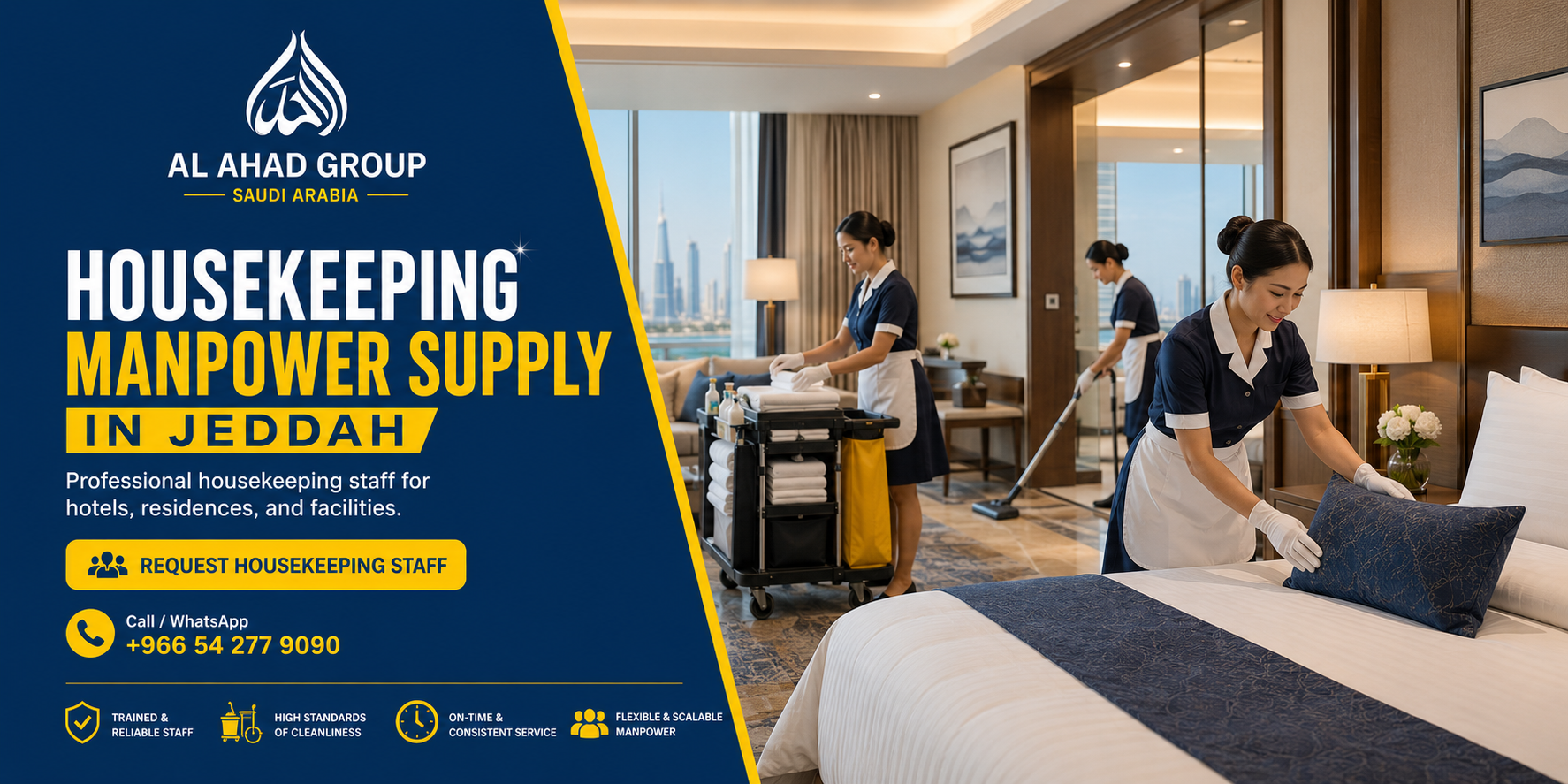
Housekeeping support is stronger when room attendants, public-area cleaners, laundry helpers and supervisors are planned together instead of requested as isolated roles.
AL AHAD GROUP supports employers across Jeddah, Riyadh and Saudi Arabia with manpower supply, overseas recruitment, contract staffing, facility management manpower, cleaning staff, housekeeping teams, technicians, logistics personnel, hospitality staff and project workforce solutions.
AL AHAD GROUP
Al Faisaliyah District, Jeddah, Saudi Arabia
Call: +966 56 847 9090
WhatsApp: +966 54 277 9090
Email: info@alahadgroup.com
AL AHAD GROUP
Riyadh, Saudi Arabia
Call: +966 56 847 9090
WhatsApp: +966 54 277 9090
Email: info@alahadgroup.com