Integrated service review
Employers usually compare cleaners, housekeepers, HVAC support, MEP technicians, maintenance staff and supervisors together before they review staffing solutions.
 AL AHAD GROUP
Facility Management Staffing Solutions in Saudi Arabia helps Saudi employers define worker categories, headcount, work location, shifts, site conditions and the required start date before supply or recruitment is confirmed. Share the approved scope with AL AHAD GROUP so the team can review the practical next step, availability and quotation requirements.
Employers usually compare cleaners, housekeepers, HVAC support, MEP technicians, maintenance staff and supervisors together before they review staffing solutions.
Monthly terms, shift structure, service hours, site access and replacement timing all affect FM staffing comparison.
Share the city, facility type, headcount and operating scope so the staffing request is easier to compare and approve.
Employers usually define cleaners, housekeepers, specialized support staff, maintenance crews and supervisors before comparing staffing options.
Building type, shift model, service hours, help-desk expectations, tools responsibility and replacement timing should be clear before pricing.
FM staffing pages should surface full-service scope early so employers do not need to piece together cleaning, technical and maintenance support from separate pages.
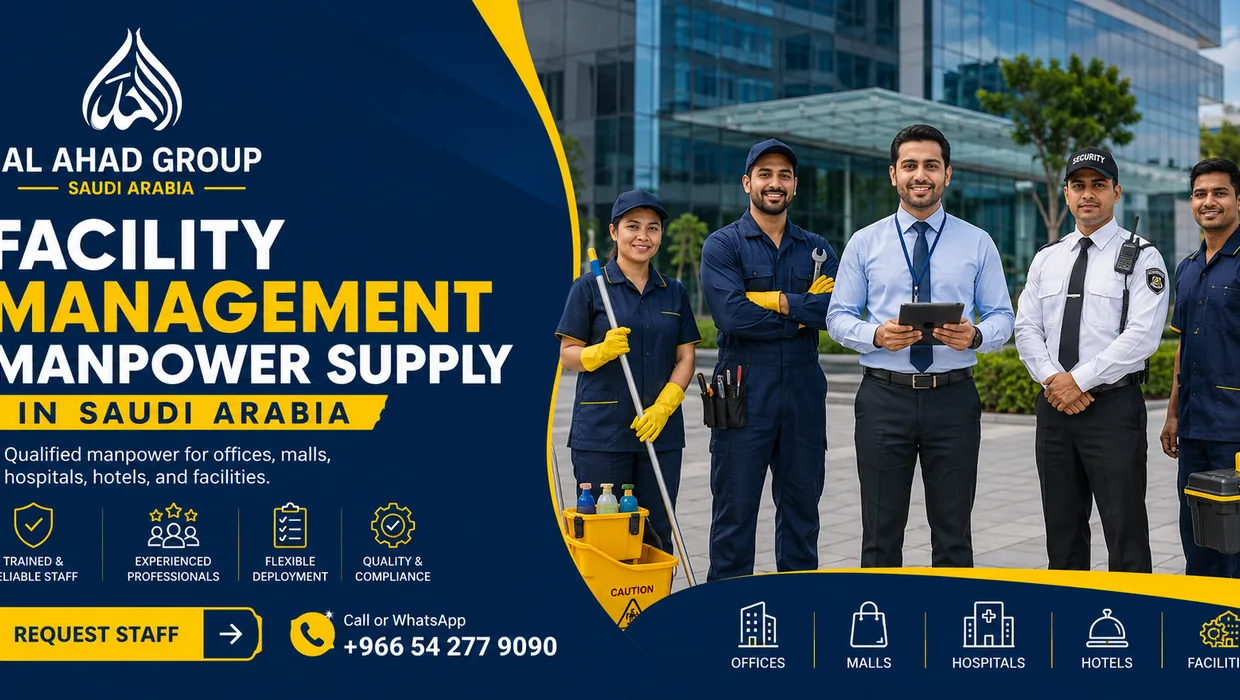
Facility Management Staffing Solutions in Saudi Arabia for Employers should start with the full FM workforce mix rather than a broad facilities claim. Employers usually need cleaning teams, housekeeping support, HVAC helpers, MEP technicians, maintenance workers, supervisors and replacement planning reviewed together.
This page now leads with that integrated FM requirement so employers can define service scope, site type, shift coverage and continuity expectations before quotation.
Confirm whether the requirement covers cleaners, housekeeping staff, HVAC helpers, MEP technicians, maintenance workers, supervisors or recurring mixed-service support.
Share city, property type, headcount by shift, service hours, contract duration, start date and replacement expectations before staffing review.
Clarify whether the site also needs monthly manpower planning, outsourcing support or broader facility-management workforce coverage.
Confirm whether the requirement covers cleaners, housekeeping staff, HVAC helpers, MEP technicians, maintenance workers, supervisors or recurring mixed-service support.
Share city, property type, headcount by shift, service hours, contract duration, start date and replacement expectations before staffing review.
Clarify whether the site also needs monthly manpower planning, outsourcing support or broader facility-management workforce coverage.
Facilities guides are stronger when they help employers distinguish cleaning, HVAC, MEP, maintenance, support staff, and supervisor coverage clearly.
Employer trust improves when the page explains replacement pressure, shift continuity, monthly workforce rhythm, and reporting needs.
Facilities staffing performs better when it connects site support with ongoing service delivery, quote-ready action, and planning support instead of generic facilities language.
Some employers still compare facilities staffing with outsourcing and broader manpower plans before they choose a final service model.
Clarify whether the workforce supports commercial buildings, industrial sites, hospitality operations, healthcare facilities, or mixed-use properties.
Check whether the requirement centers on cleaners, technicians, support staff, supervisors, or recurring mixed-service teams.
Use the facilities manpower, workforce-support, and outsourcing pages when the employer still needs guide validation before award.
Use the quote page once service categories, shift structure, and continuity pressure are clear enough for review.
Because employers often compare direct staffing with recurring-service workforce models before they choose a provider.
Generic facilities wording without enough employer-planning depth and decision-ready detail usually weakens them first.
Employers managing recurring facilities operations and workforce continuity across Saudi sites.
Send the service categories, shift model, and monthly workforce pressure so the Saudi team can review the strongest facilities staffing page.
Facility management manpower is strongest when cleaning staff, housekeeping, HVAC helpers, MEP technicians, maintenance helpers and supervisors are planned as one operating requirement.
Share the asset environment, trade mix, shift cover and response requirement. A precise requirement lets the team assess facilities and maintenance teams, timing and the next practical step without guessing.
Yes. Confirm the work location, access rules, reporting point, working hours and any site-specific controls so the plan reflects the actual operation.
The employer approves a role-by-role schedule covering duties, headcount, supervisor needs, shift allocation and any relief or replacement coverage.
Timing depends on worker availability, selection decisions, documents, site readiness and competency evidence, tools, access and escalation. Dates are confirmed only after the requirement is reviewed.
Send the approved role list, quantities, location, schedule, contract period and target start date through the page enquiry route for a documented review.
AL AHAD GROUP supports employers across Jeddah, Riyadh and Saudi Arabia with manpower supply, overseas recruitment, contract staffing, facility management manpower, cleaning staff, housekeeping teams, technicians, logistics personnel, hospitality staff and project workforce solutions.
AL AHAD GROUP
Al Faisaliyah District, Jeddah, Saudi Arabia
Call: +966 56 847 9090
WhatsApp: +966 54 277 9090
Email: info@alahadgroup.com
AL AHAD GROUP
Riyadh, Saudi Arabia
Call: +966 56 847 9090
WhatsApp: +966 54 277 9090
Email: info@alahadgroup.com